



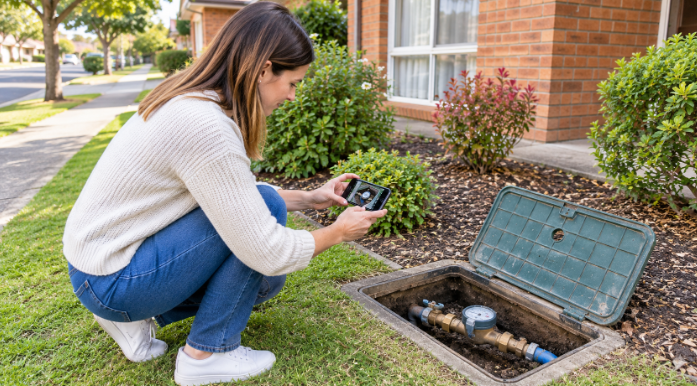
If you suspect a hidden water leak in Melbourne, check for immediate danger and unexplained water use. Contact your water retailer if public infrastructure may be involved, or a licensed plumber for suspected private plumbing. Renters should notify their rental provider or agent. Before approving significant work, ask for the findings and a written, itemised quote.
A damp patch behind the skirting board or a sudden jump in your water bill can make an expensive repair feel inevitable. Yet calling the first number you find, without checking where the water might be coming from, can lead to delays or the wrong investigation.
If you are searching for leak detection Melbourne services, start with the seven checks below. You will learn who to call first, when a water retailer may be responsible, how homeowners and renters should approach costs, and what proof to request before anyone starts opening walls or floors.
What Should You Check Before Booking Leak Detection in Melbourne?
Not every wet patch means a broken water pipe. These seven checks help you sort urgent risks from ordinary troubleshooting and provide useful information when you contact a professional. Only inspect areas that are safely accessible; do not dismantle plumbing or disturb electrical equipment.
1. Is water escaping rapidly or creating a safety hazard?
An active burst pipe, significant flooding or water near electrical equipment needs urgent attention. If safe, isolate the water supply using an accessible stop tap, keep people away from affected electrical installations and contact a licensed plumber. Do not touch wet switches or enter an area with a sagging ceiling.
If the check fails: Seek urgent help rather than delaying for a four-hour meter test or multiple quotations.
2. Does the water meter move when nobody is using water?
Record or photograph the water meter, then make sure taps, toilets, appliances, garden irrigation, and evaporative cooling are not drawing water. Keep the meter supply on during the test and avoid water use for four to five hours. If the reading changes, repeat the test to rule out accidental usage.
A moving meter can indicate water loss, but it does not prove there is a concealed pipe leak. Greater Western Water’s meter-testing guidance recommends repeating an unexpected result before calling a licensed plumber.
If the check fails: Arrange an assessment, especially if the reading keeps increasing.
3. Could the source be a tap, toilet or appliance?
Look for visible drips under sinks, a toilet cistern that continually refills, a leaking garden tap, a faulty flexible hose or moisture near a hot water unit. These can add to water bills without producing an obvious damp wall. Most importantly, do not disconnect hoses or remove panels to investigate.
Where the source is clearly a fitting, leaking tap repair may be more appropriate than extensive concealed-pipe testing.
If the check fails: Tell the plumber which fixtures you have ruled out and when the water usage occurs.
4. Does the damage appear mainly during rain?
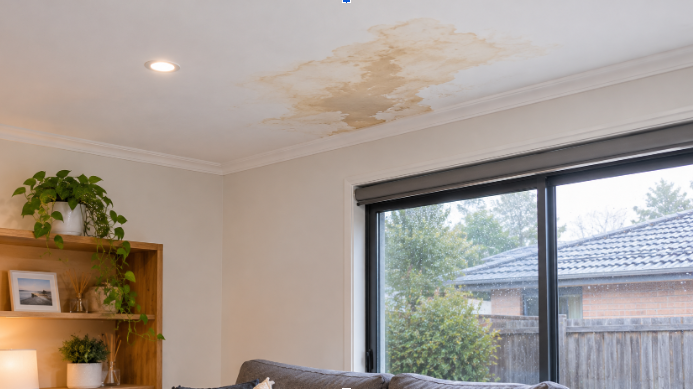
Water staining that gets worse during storms may be entering around roof flashings, gutters, windows or other parts of the building envelope. Wind-driven rain and water flowing over sloping ground can make the entry point difficult to identify. The damp area inside may be some distance from where water entered.
A roof leak repair assessment may be the sensible first step when symptoms consistently follow rainfall.
If the check fails: Note when the stain appears, photograph it and avoid climbing onto a wet or damaged roof.
5. Is water backing up through a drain or fixture?
A slow-draining shower, gurgling sink or wastewater rising through a floor waste suggests a different system from the pressurised water supply. A blocked drain or damaged wastewater line can cause localised flooding, particularly when fixtures are used, or stormwater systems are under strain.
Because drain cameras and clearing equipment serve a different purpose from acoustic leak detection, tell the plumber whether the problem occurs only while water is being discharged.
If the check fails: Stop using affected fixtures and arrange a blocked drain assessment.
6. Is the suspected leak at the meter, on private pipework or on a shared service?
The physical location of a fault affects who should investigate it. For many individual homes, the water retailer maintains the network and meter, while the owner maintains private piping after the meter. However, shared water mains, multi-unit complexes and unusual meter arrangements can change that division.
Yarra Valley Water’s responsibility guidance explains the typical boundaries and important exceptions.
If the check fails: Ask your water retailer or owners corporation manager to clarify the connection before approving non-urgent work on shared infrastructure.
7. Is there clear evidence for the recommended repair?
Ask the plumbing professional what was inspected, what each test found and whether the source is suspected or confirmed. If the proposal involves cutting concrete, opening a wall or removing tiles, request an explanation of why that particular location has been chosen and what other causes were considered.
If the check fails: Request the findings in writing and an itemised quotation. For substantial, non-urgent destructive work, a second opinion can be sensible; urgent safety repairs should not be delayed solely to obtain extra paperwork.
Is It a Burst Pipe, Roof Leak or Another Plumbing Problem?
The pattern of water damage often provides a useful clue, although a professional inspection is needed to establish the cause. So, you may mention the symptoms below to describe the problem accurately instead of choosing a test or repair method in advance.
| What you notice | Possible cause | Who to contact first |
| Unexplained meter movement; no visible drips | Concealed supply leak or faulty water-using fixture | Licensed plumber for assessment |
| Water escaping from a damaged pipe | Burst Pipes | Urgent Burst Pipe Plumber |
| Ceiling stains appearing mainly after rainfall | Roof or external water ingress | Roof plumber or water-ingress specialist |
| Dripping tap or obvious fitting leak | Worn or faulty fitting | Plumber for Leaking Tap Repair |
| Wastewater rising or draining slowly | Blocked Drain or damaged waste pipe | Drainage plumber |
| Water pooling near meter or public main | Possible retailer infrastructure fault | Relevant water retailer |
When to Contact a Burst Pipe Plumber
A rapidly spreading wet area, sudden loss of pressure or water escaping from a damaged line calls for prompt attention. A burst pipe plumber can assess whether the pipe needs isolation, access and replacement, while explaining the consequences of leaving the fault active. The exact repair depends on the pipe material, location and damage.
When Roof Leak Repair May Be Needed
Rain-linked ceiling damage is not proof that the roof is at fault, but it helps direct the initial investigation. If water appears during particular weather conditions, share photographs, rainfall timing and details of any earlier repairs so the professional can consider roof drainage and external entry points.
When Leaking Tap Repair Is Enough
A visible leak at a tap, connection or fixture may be straightforward to diagnose. In that situation, a targeted repair is more proportionate than booking a full concealed leak investigation, provided there is no unexplained water damage elsewhere.
Who Pays for Water Leak Detection Melbourne?
The answer depends on whose plumbing is affected, who authorised the investigation and whether an insurer or water retailer offers assistance. A charge for detecting the leak, a repair invoice and the cost of excess water usage are three separate questions; the same party does not necessarily pay all three.
The Water Retailer’s Responsibility
In a typical home connection, a Melbourne water retailer is responsible for parts of the water network and the meter, while the owner is responsible for private pipes on their side of the connection.
The exact dividing point may differ, especially for private water mains and properties with several dwellings. If the fault appears to be at the public connection, contact your retailer before commissioning major private work.
However, water visible in the nature strip may not be a public-main leak: private services may also run through those areas. The retailer can advise how it identifies responsibility, and whether any reimbursement or high-usage review is available under its current conditions.
Homeowners, Renters and Owners Corporations
For an owner-occupied detached house, the owner normally arranges and pays for work on their private plumbing. However, for a rental, the renter should notify the rental provider or agent promptly and document the problem; Consumer Affairs Victoria lists burst water services, serious roof leaks and flooding among urgent repairs and explains the process where urgent work is not organised.
In apartments and townhouses, shared pipes and common property may involve the owners corporation. Before deciding who pays, always check the plan of subdivision, the location of the damaged service and any advice from the building manager and water retailer. Being physically close to another unit does not by itself establish liability.
Will Insurance or a Water-Bill Allowance Help?
Home insurance sometimes responds to resulting water damage or to specified leak-location and access costs, but it may exclude the defective pipe or gradual damage. Ask the insurer what documentation is needed before authorising non-urgent demolition. Keep the inspection report, photographs, quotations and invoices together.
Some retailers may also consider an adjustment following an eligible concealed leak. However, requirements can include an eligible type of leak, prompt repairs and a plumber’s statement. Check the policy of your own water retailer rather than assuming an automatic rebate.
| Situation | Who to approach first | What decides payment |
| Suspected retailer infrastructure fault | Water retailer | Connection boundary and retailer rules |
| Leak on private household plumbing | Licensed plumber/homeowner | Repair scope and property ownership |
| Rented property | Rental provider or agent | Victorian rental law and cause of damage |
| Shared pipe in a multi-unit property | Owners corporation manager | Title, subdivision plan and service ownership |
| Possible insurance-related damage | Insurer | Policy wording, cause and evidence |
What Evidence Should You Request Before Approving Repairs?
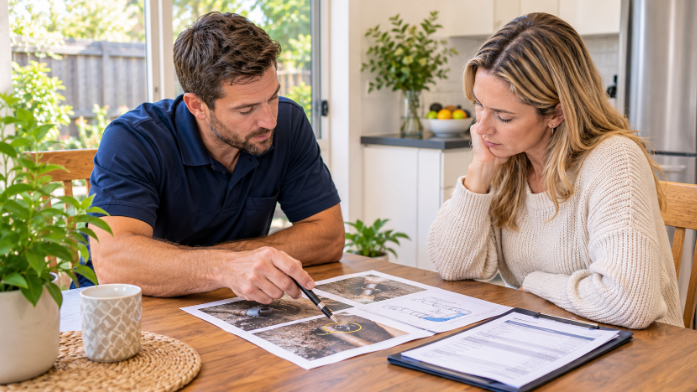
Finding a damp area is not the same as confirming the source. Before approving significant work, ask for a plain-English explanation of what the inspection established and how the recommended repair follows from that evidence. A useful record should distinguish firm observations from possible explanations.
A practical pre-approval checklist is:
- Inspection scope: Where did the plumber inspect, and which areas were inaccessible?
- Tests and results: Were meter, pressure, acoustic, thermal or tracer-gas tests used, and what did they show?
- Location confidence: Is the source confirmed or only the most likely explanation?
- Repair options: What work is proposed, and is there a less invasive way to confirm the fault?
- Itemised quote: Does it separate investigation, access, plumbing repair and reinstatement?
- Post-repair check: How will the repair be tested, and what documents will you receive?
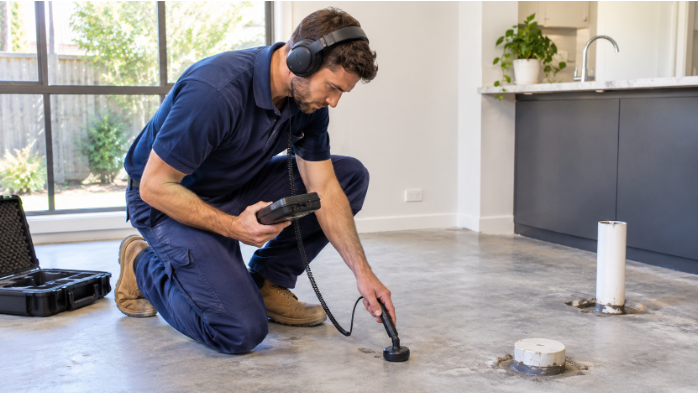
Specialist leak detection equipment can narrow the area to investigate, but it cannot promise that every fault will be pinpointed without opening a surface. If the evidence remains inconclusive, ask what the next diagnostic step will be and what it may cost.
How Much Can Detection and Repair Cost?
A cheap inspection can become expensive if it leaves out the work needed to reach and repair the fault. Instead of comparing one headline call-out price, compare the total scope and ask what happens if the cause cannot be confirmed at the first visit.
- Attendance and testing: What is included in the initial fee, and is additional time charged?
- Report: Will you receive the test findings and an explanation of the suspected location?
- Access: Are wall, tile, floor or slab-opening costs included?
- Plumbing repair: Is repair of the failed pipe or fixture a separate quotation?
- Reinstatement: Who restores waterproofing, plaster, flooring or landscaping afterwards?
- After-hours work: Are there additional charges for urgent attendance?
As an illustrative calculation only, a $450 investigation, $700 pipe repair and $1,200 reinstatement would total $2,350 before other charges. Those figures are hypothetical, not MKS Plumbing prices or a Melbourne market average. An actual quote depends on access, diagnostic complexity, materials and the extent of damage.
How Plumbing Maintenance Helps Prevent Further Problems
Not every leak can be prevented, particularly where concealed pipes fail unexpectedly. Nevertheless, periodic plumbing maintenance can help reveal dripping fittings, deteriorating hoses, troublesome hot water connections and repeated drain problems before they worsen.
Take a fresh water-meter reading when household usage changes unexpectedly, inspect accessible fittings and keep roof drainage clear where safe. After a repair, retain the photographs, diagnostic notes and invoices so future plumbers can understand the history of the problem. For recurring issues, maintenance plumbing provides a practical starting point.
A gas leak needs a completely different safety response from a water leak. If you suspect gas, avoid flames and electrical switches, keep clear of the affected area and contact the gas distributor’s emergency line; call 000 where there is immediate danger.
Frequently Asked Questions
For suspected private plumbing, contact a licensed plumber. If the fault appears to be at the meter or public main, contact your water retailer; renters should promptly notify the rental provider or agent.
It depends on the water retailer’s connection boundary. Retailers usually maintain their network and the meter, while owners maintain private plumbing, but private mains and multi-unit connections can be exceptions.
Fees depend on the time, equipment and access required. Ask for an itemised quote that distinguishes detection, reporting, repair, destructive access and reinstatement.
Some policies may cover leak location, access work or resulting damage, but exclusions and excesses vary. Check the policy and ask your insurer what evidence to provide before non-urgent work.
It should describe the areas inspected, methods used, relevant findings, suspected or confirmed source, limitations and recommended next steps. Also, a repair quote should be supplied separately or clearly itemised.
Yes. Both may create wall or ceiling stains. Damage that appears mainly after rainfall can suggest roof or external water ingress, while unexplained meter usage may point towards private water-supply plumbing.
Notify your rental provider or agent immediately. They generally arrange and pay for urgent repairs not caused by the renter, subject to the specific rules and circumstances explained by Consumer Affairs Victoria.
A damp wall, unexplained meter reading or recurring leak is easier to deal with once the likely source has been properly investigated. If your initial checks do not identify the problem, discuss the symptoms with a qualified plumbing professional before committing to extensive repair work. Also, to ask about the most appropriate next step, you may contact the team of professionals and explain what you have noticed, when the problem occurs and what you have already checked.